
A lot of people offer guitar setups, but you’ll see all sorts of different prices around.
Why is this? Well, the list of things a guitar setup can include is not ‘standardised’ in the guitar industry.
So not all guitar setups are created equal – so I thought I’d explain what I offer at Stu’s Guitar Setups Haywards Heath – and why I include the services that I do.
The TLDR: I believe that a good setup is not just about adjusting the truss rod and action height, giving it a clean and polish and calling it a day. I think a great setup is about making sure you have level frets, and that nut slots are the right height.
What my guitar setups include at a glance
- I go into detail below, but here is the at a glance list of what my setups include as standard:
- Truss rod adjustment – the cornerstone of any setup in electric and acoustic guitars and basses
- Action height adjustment
- Intonation
- Saddle radius adjustment (where relevant)
- Nut slot height
- Check for level frets (set neck completely straight and check every fret)
- Spot level up to 4 frets (as part of setup)
- Check grounding on electrics
- Clean electrics (to get rid of unwanted crackles)
- Tighten up output jacks, screws etc
- Ensure tremolo is set up correctly (where relevant)
- Polish frets
- Condition fretboard (where relevant)
- Clean and polish guitar
Now lets go into some detail on the parts most other setups don’t include…
Guitar / bass action height
Now the reality is, most people want the action as low as possible on their guitar or bass.
In fact, the popular terms (which is a bit of a running joke in the guitar tech community) is..
“as low as possible without buzz”
I literally have a T-shirt with that on! 😀
But, what does it actually take to make that happen?
I think anyone offering setups will try and achieve that BUT what is really important is where they stop.
You can just adjust the truss rod correctly then lower the action height until you find the point it buzzes, and then raise it ever so slightly and call it job done.
A lot of people will do that. But I don’t…
I want to get to the bottom of why it’s buzzing – and can it be fixed.
9 times out of 10 (maybe 8), fret buzz will be caused by high frets. Fret 10 too high? Frets 9 and likely 8, will buzz.
To me this is the key to a really good set up – level frets.
Spot levelling frets for low guitar and bass action
So if level frets are my key to a great playing, low action guitar setup – how do I make sure they are level?
Make sure the neck is straight
The 1st step is to make sure that the neck is actually straight. You do this through adjusting the truss rod, whilst measuring the neck relief until there is zero.
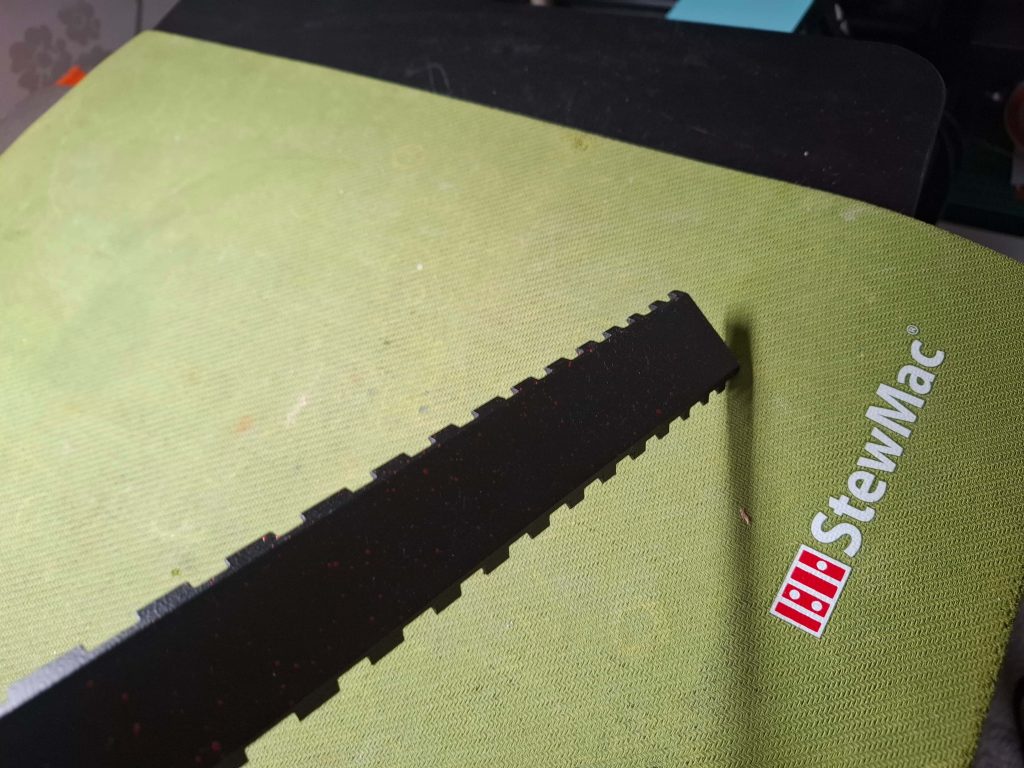
Now I used to use a notched straight edge to do this – and it works well enough. Using a backlight and feeler gauges you can get a pretty good read of the neck.
However, now I use the Proper Relief Gauge – which is an incredibly accurate (to 0.0001 of an inch) – and expensive – digital gauge.
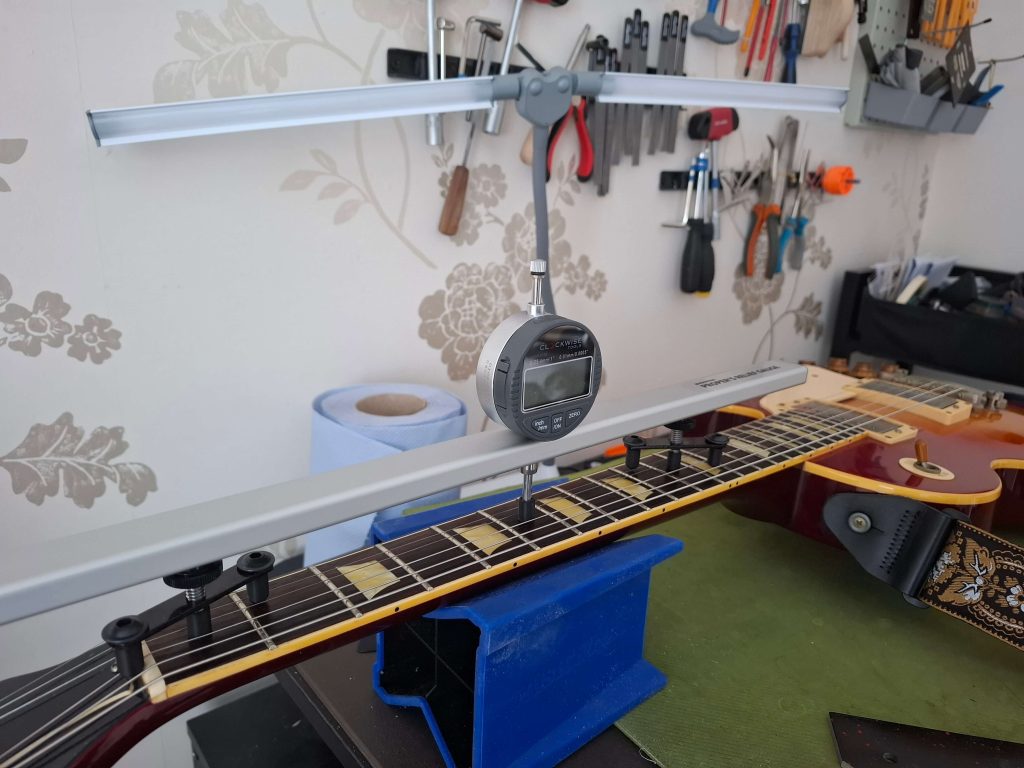
This allows me to measure all parts of the neck very very accurately – and will easily identify any warps in the neck, or ‘ski jumps’ where the neck meets the body.
Once it’s straight (or as straight as it can be) then it’s on to the next step…
Using a fret rocker
A fret rocker is a simple tool – but very useful.
You use it by spanning it across 3 frets at a time, and the theory is – if it rocks, then the middle fret is higher than the other two.
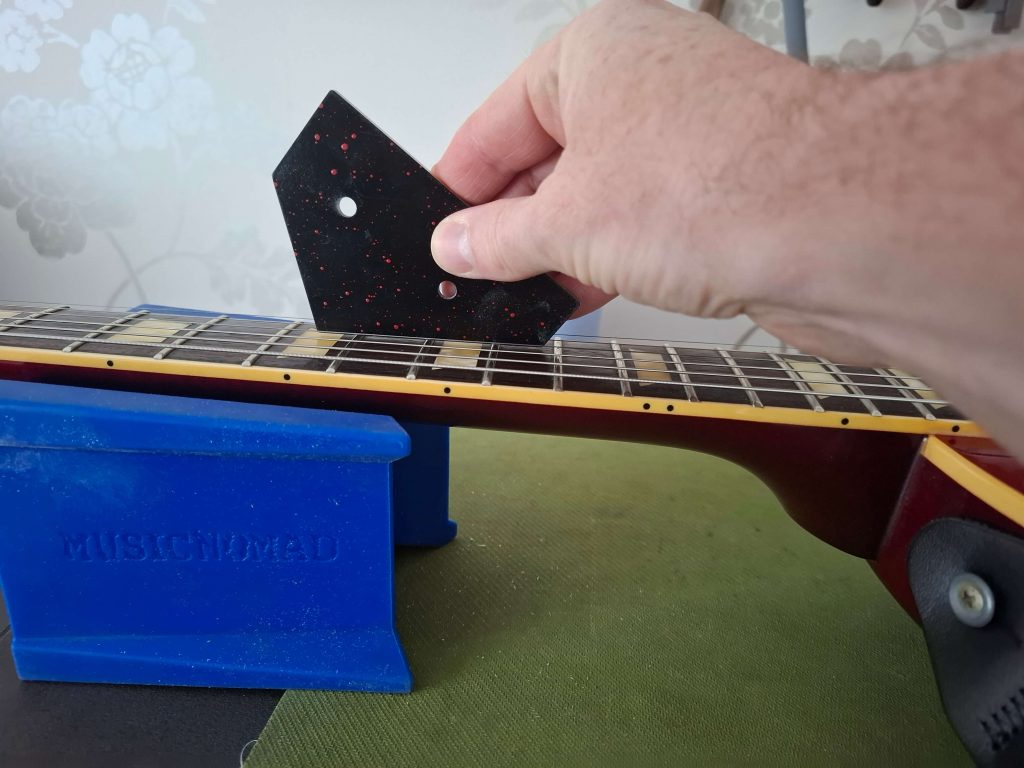
There are some edge cases where that might not be the case, but most of the time that’s it.
So then, using the fret rocker I check every part of every fret (frets are rarely high in a uniform way) noting down the areas that are an issue.
As part of my setup fee, I will spot level up to 4 frets – if you have a lot of problem frets, then you’ll benefit from a full fret level and re-crown. But I will always contact you 1st to advise on this and see how you’d like me to proceed.
So now I know where the problem frets are – I need to sort them!
Making the frets level
The 1st thing to try is to reseat the frets – sometimes they can pop out of their slots a bit, and need to be ‘persuaded’ to go back in. This delicate operation requires the use of a fretting hammer…
If that doesn’t do the job, then it’s time to actually spot level the frets.
Spot levelling means take the top off of the offending fret(s) until they are the same height as all the others.
Of course once you’ve done that – this leaves your frets with a flat top – you don’t want that…so then I re-crown them to restore the shape and polish out any scratches.
Once all the frets are sorted we can then set the action nice and low, to play without fear of nasty buzzes 🙂
Nut slot height
The height of your nut slots has some effect on the general action of the guitar as a whole, but you will really feel the benefit around frets 1,2 and 3.
If the slots are too high, not only does it take effort to play at the top of the neck, but it will also affect the intonation of the guitar, making notes and chords out of tune.
Using a combination of very accurate digital calipers and feeler gauges I asses the distance between the top of the 1st fret and the bottom of the strings.
If the gap is too great, then I file the slots (using the highest quality nut files) to the correct height.
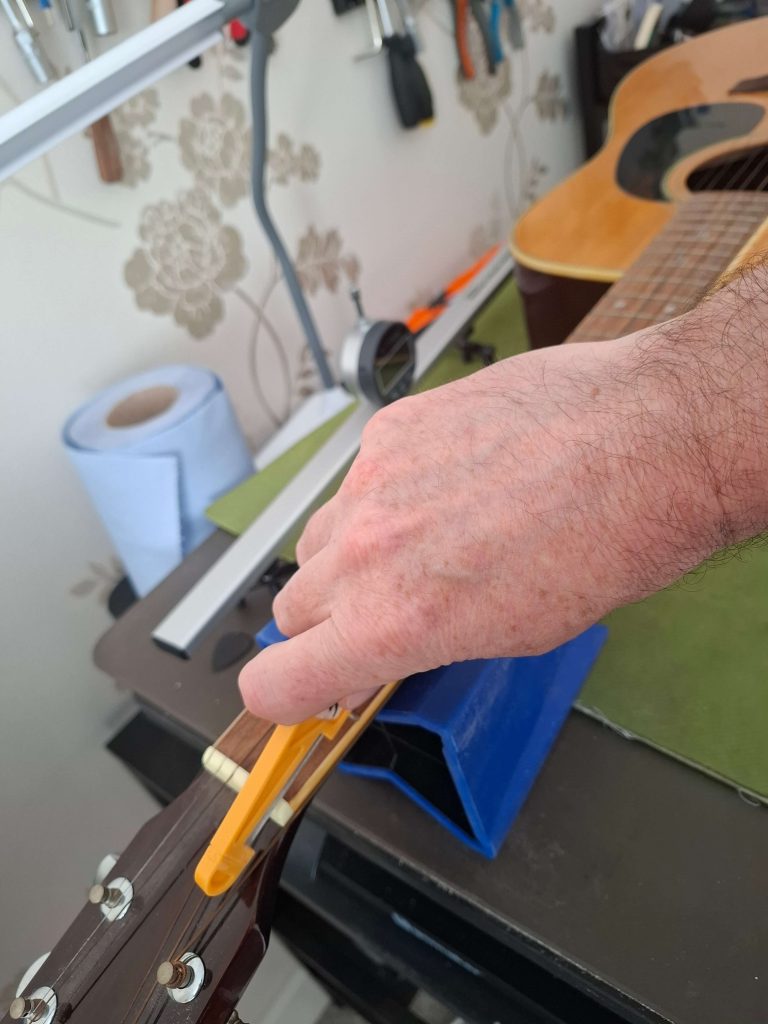
This can really transform how a guitar or bass feels to play – my customers are always pleasantly surprised!
How much I charge for a full setup
At the time I write this (June 2026) my setup fee is £70 for guitar or bass (including a standard non locking trem/bridge).
Hopefully you can understand the benefit of my approach, and why it may cost more than other prices you see – but actually includes a lot more, that ends up with your guitar playing much, much better.
Just check my reviews – don’t take my word for it 🙂
Had Stu do setups on two guitars - a Martin and a slightly unusual almost-vintage Ovation. He did an amazing job - improved playability, rectified things that should have... read more

 Tim Allen
Marvellous job with vintage gear treated with care. Two guitars playing and sounding great. Stu comes highly recommended.
 Peter maxted
Had my new guitar serviced with Stu and he’s done a fantastic job, I couldn’t be happier. Discussions were had as to what style I played, he advised on the... read more
 Rob Hitchcock
Stu did a fantastic job sorting out the action and neck relief on my Gibson acoustic. It now plays incredibly well. Great communication from Stu through the whole process, and he... read more
 Russell Edmonds
Stu is amazing at looking after my guitars. I've been a professional guitarist all my adult life. I've got a lot of guitars and I've had quite a lot of... read more
 Joe Kaye
Id been struggling for ages to get the action lower on my USA strat, I kept getting buzzes everytime it got lowe. Stu did some spot levelling and a setup... read more
 Jamie
JamieWant to book a setup? Email me and I’ll book you in!
Cheers Stu