
If your guitar is making more racket than a toddler on a drum kit, guitar cavity shielding may be worth a look.
Buzz, hum and electrical interference can turn an otherwise lovely instrument into a bit of a nuisance, especially if you play near computer screens, LED lights, pedalboards or less-than-ideal wiring.
As a local Sussex-based Guitar Tech, I see this sort of thing all the time.
The good news? In the right guitar, cavity shielding can be a simple, affordable way to reduce unwanted noise and make the instrument far more pleasant to play.
Why is my guitar so noisy?
That depends. Some noise is perfectly normal, particularly with single-coil pickups.
They’re brilliant for sparkle and clarity, but they can also be a bit like fussy old radios — lovely when they behave, grumpy when the room is full of interference.
You might notice noise when:
- sitting near a computer monitor
- playing under LED lighting
- using a daisy-chained pedal power supply
- recording at home
- facing one direction in the room and then turning slightly
- using higher gain settings
In many cases, the guitar’s electronics cavity is letting in more electrical interference than it ought to. That’s where shielding can help.
What is guitar cavity shielding?
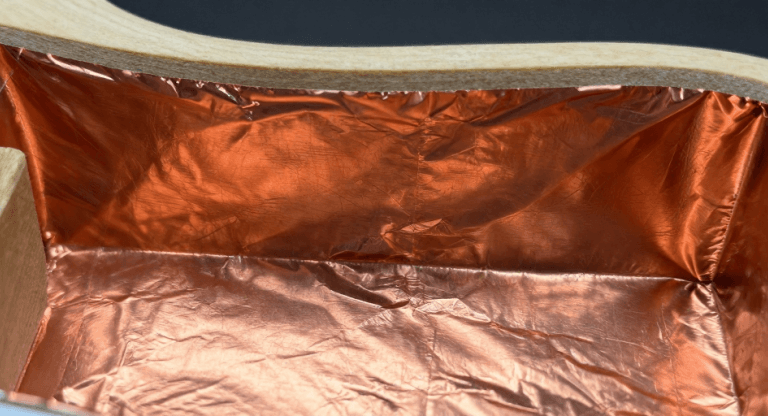
Guitar cavity shielding is the process of lining the control cavity, and sometimes the pickup cavities, with conductive material to help block outside interference from getting into the electronics.
That material is usually one of two things:
- copper foil (my personal preference)
- conductive shielding paint
Think of it as putting your guitar’s wiring in a slightly better insulated little bunker.
It won’t change the basic character of the pickups, and it won’t magically make a single-coil guitar silent as the grave, but it can help reduce the background buzz and interference that makes a guitar feel noisier than it should.
What problems can guitar cavity shielding help with?
This is the bit most players actually care about, and fair enough too.
Shielding can often help with:
- unwanted background buzz
- electrical interference from screens, lights and power supplies
- noisy control cavities
- extra hiss or hash in home studio environments
- cleaner performance when recording or gigging
It tends to be especially worthwhile on guitars with single-coil pickups, where every little bit of noise reduction helps.
If your guitar sounds fine until you stop playing, and then starts humming away like a fridge in a bedsit, shielding may well be part of the answer.
What guitar cavity shielding will not fix (important!)
Here’s where we keep our feet on the ground. Shielding is helpful, but it is not wizardry.
It will not fix:
- faulty grounding
- broken or poor-quality cables
- noisy pedals or power supplies
- amplifier hum
- worn-out electronic components
- the inherent nature of single-coil pickups
That last one matters. Single coils will still pick up some hum because that’s part of how they work.
Proper shielding can reduce interference getting into the circuit, but it won’t turn a Strat into a Les Paul. That would be like fitting winter tyres and expecting the car to become a helicopter.
So yes, shielding can improve things. No, it is not a cure for every electrical gremlin under the sun.
Which guitars benefit most from shielding?
Some guitars are much more likely to benefit than others.
The usual suspects are:
- Strat-style guitars
- Telecasters
- Jazz Basses and other single-coil basses
- guitars used in home studios
- instruments played near computers, interfaces and monitors
- older guitars with minimal or poorly applied factory shielding
That said, even humbucker-equipped guitars can sometimes benefit if the control cavity is poorly shielded or the environment is particularly noisy.
It is not just about pickup type. It is also about the guitar, the wiring, and the environment you are using it in.
Copper foil vs shielding paint
Both can work well when applied properly.
Copper foil is popular because it offers excellent conductivity and can create very reliable coverage when installed neatly. Conductive paint can also do the job, especially where the cavity shape makes foil more awkward.
What matters most is not just the material, but the quality of the work:
- proper coverage
- tidy application
- continuity between sections
- correct grounding
In other words, it is not just a case of sticking shiny stuff in a cavity and hoping for the best. Done badly, shielding can be messy, ineffective or create other issues.
Done properly, it can make a real difference.
How I approach guitar cavity shielding
When I carry out guitar cavity shielding, I do not just dive in like a bloke attacking flat-pack furniture with a butter knife.
The process usually looks like this:
- inspect the guitar and assess the noise issue
- check whether shielding is likely to help
- remove the necessary hardware and electronics access points
- apply shielding neatly to the relevant cavities
- ensure continuity and grounding are correct
- reassemble and test the guitar
That last part matters. There is no point doing the work if nobody checks whether it has actually improved the instrument.
Sometimes shielding is the right fix. Sometimes it is only part of the picture. A proper diagnosis saves time, money and head-scratching later.
How much does guitar cavity shielding cost?
At GuitarSetups.co.uk, cavity shielding starts at £30.
The final cost can vary depending on:
- the type of guitar
- how much disassembly is needed
- whether the pickup cavities also need treatment
- whether any other wiring or grounding issues are uncovered
If the guitar already has other electrical problems, those may need sorting at the same time. It is a bit like taking your car in for a tyre wobble and discovering one of the wheels is barely hanging on. Better to know.
If you’re getting this done as part of a full guitar setup, there might be something we can do on the price 😉
Is guitar cavity shielding worth it?
In the right guitar, yes — absolutely.
If your instrument is suffering from buzz and interference caused by poor or absent shielding, this can be a relatively low-cost upgrade that makes the guitar quieter, cleaner and more enjoyable to use. It is especially worthwhile if you record at home, use gain, or regularly play in environments full of electrical interference.
Will it make every noisy guitar dead silent? No. But can it make a noticeable improvement in the right circumstances? Very often, yes.
And sometimes that is all you need. Not perfection. Just a guitar that stops hissing at you every time you take your hands off the strings.
Book guitar cavity shielding in Sussex
If your guitar is noisier than it should be, I can help work out whether shielding is the right solution. As a local Sussex-based Guitar Tech, I offer practical, no-nonsense guitar electronics work without the faff.
Shoot me an email and we’ll get your guitar sorted!